Pandemic. A word that for a modern generation is something we perhaps dismiss as being outdated and no match for the advanced 21st Century medical system. Or, on the other end of the spectrum, maybe we confine it to futurism and science-fiction novels.
While the British Government this time 100 years ago were in the midst of celebrating victory over Germany in the First World War, is it possible that June of 2020 has united the world once more in a global battle? Except this time, against one common enemy – Covid-19. From evacuation to quarantine, rearmament conferences to PPE, and rationing to bulk buying, the world seems to have undergone a radical and long overdue shift in its defence strategy. Many of us are guilty of sitting comfortably in an ivory tower and assuming that living in a developed country makes one exempt from such issues. However, the face of that assumed invincibility is changing. Despite Bill Gate’s assertion in 2015 following the outbreak of Ebola;
“If anything kills over 10 million people in the next few decades it’s most likely to be a highly infectious virus…not missiles but microbes.”
it was rather dismissed by authorities and one can’t help but wonder whether the intensity of the coronavirus outbreak is the only thing that could give humanity the wake up call we evidently need.
Pandemics and Epidemics are no novelty to the 21st Century, and by tracing them through history we can see both how medicine has developed, but also the worrying increase in their frequency. Whether or not medical efficiency is cancelled out by the growing proximity of them is something yet to be explored.
The increasing proximity of both pandemics and epidemics is perhaps indicative of a wider issue that the government are failing to address – climate change? the meat industry? nuclear production? genetic modification? These events are undoubtedly connected, and one cannot be dealt with in isolation. All is well that the experts know the answers and ‘quick-fixes’ but what about all of us? What about the people who are actually able to initiate widespread change?
Where scientific developments have helped us answer a plethora of questions about our past, there is an evident disparity between communication about the past, and the trajectory of our scientific future. While we are constantly reminded of our bleak future regarding issues like climate change, there is a lack of communication between scientists and the public to explain the reasons for the anticipated trajectory of the coronavirus specifically, but also how we can prepare for future pandemics. Instead of invoking change, this ambiguity creates a chain reaction; a lack of explanation and understanding tiggers an inability or unwillingness to inspire activism to prevent the reoccurrence of such issues.
History of Some of the Worst Global Pandemics Since Ancient Greece:
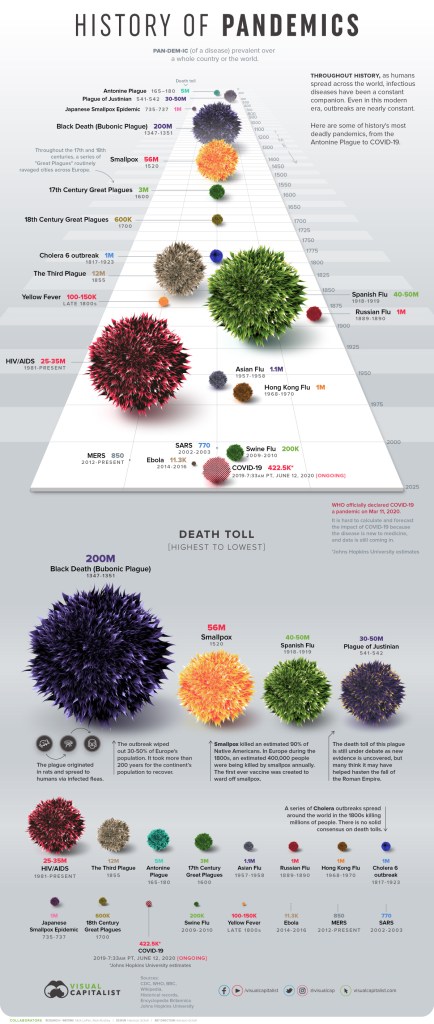
Plague of Athens: 430 B.C. – Taking place shortly after the war between Athens and Sparta with some estimates putting death tolls as high as 100,000 people. Bearing in mind the significantly lower population numbers
The Black Death: 1346-1353 – Stretched from Asia all the way to Europe as a result of an excess of the Yersinia pestis bacterium. Estimated death toll of 25 million people.
The Great Plague of London: 1665 – Tearing through London in 1665 and 1666, the bubonic plague killed 20% of the population of London. The disease was believed to be transported through animals, and as a result, thousands of cats and dogs were slaughtered.
Spanish Flu: 1918-1920 – Spanish Flu affected people from the South Seas to the North Pole with around 100 million deaths. World War I undoubtedly acted as a catalyst for Spanish Flu. While Spanish Flu did not start in Spain, it had one of the lowest levels of censorship, and therefore the first reports of the pandemic came out of Spain.
Aids Pandemic 1981-present day – The AIDS death toll stands at 35 million world wide. Since its discovery, it has effected people predominantly in Sub-Saharan Africa.
H1N1 Swine Flu pandemic: 2009-2010 – Caused by an excess of H1N1 in Mexico, within one year it infected almost 1.5 million people, killing between 151,700 and 575,400 people.
West African Ebola epidemic: 2014-2016 – Tearing trough Western Africa there were 28,600 reported cases of Ebola and 11,325 deaths.
Zika Virus epidemic: 2015-present day – Zika Virus is carried by mosquitoes and victimises pregnant women infecting their unborn children causing birth defects. These children unfortunately do not live for more than a few months in best case scenarios.
Coronavirus (2002-2003, 2012-Present) – Coronavirus is an umbrella term, and Covid-19 is a single branch of that. There have been several coronavirus related pandemics such as the increasingly well known SARS, and MERS. However, since its discover in 1937, the pioneer of coronavirus has been poultry bronchitis, otherwise known as Bird Flu.
While evidently these also include epidemics, many of them had the potential to develop into pandemics. It is this potential that we should be analysing as a warning sign for the future, rather than breathing a sigh of relief at our lucky escapes. Humans have been on earth for near 7 millions years, and since then it has been ‘the world according to us’ – this is clearly changing. While human has inflicted conflict on human, and country has waged war against country, we are now being confronted with the possibility of an entirely new type of global war – one where all humans are united on one side against a new type of authority.
We can acknowledge that this is categorically not the last pandemic we will see in the next few years. However, it is crucial that we change the way in which we acknowledge them. Boris Johnson’s attitude of ‘heard immunity’ was too little too late this time round, as he felt when suffering severely from the virus himself. While comparatively Covid-19 has relatively positive statistics (depending on age and health status) compared to former pandemics, the devastation has been undeniably horrendous, with Britain’s death toll reaching almost 60,000 at present. One can only imagine what it would look like with a more aggressive virus or higher death rate percentage. I implore you to keep commending the NHS despite the termination of Thursday night clapping. From someone who has spent a large amount of time in and out of hospitals, they truly are amazing people, and they are putting themselves and their families in immense danger for our own well-being. It is down to us, as well as the government to remember the devastation of this pandemic, to stand with our NHS and key workers, and to carry this newfound solidarity in the face of devastation in the forefront of our minds as we move past Covid-19 onto different pandemics that will no doubt rear their ugly heads once more in the next few years.
Resources:
- Journal of the Plague by Daniel Defoe (1722)


2. TED Talk: Bill Gates on Pandemics as referenced above
3. Netflix Series : Pandemic
 The World According To...